giovedì 14 gennaio 2016

Radical 0 6人 Rén , person

Radical 0 6 Rén , person

"The Chinese greet each other with crossed hands and bow ! "
 

Pictographic form of character Rén  in which a man is seen in profile, bowing with crossed hands in her chest. All represent that era  Chinese man in common posture when greeting. Showing an attitude of humbleness.


The carattere Rén means human or person.  To indicate a man or a woman, you need to add a specification. 男人Nánrén,man 女人Nǚrén woman.


Many of the symbols relating to the human being have the same radical. Let’s see the characterrén which consisted of the radical Rén added Èr symbolizes two .


 The number two is the smallest element of human society. In fact, it says道生一 一生二 二生三 三生萬物Dào shēng yī,  Yī shēng èr,' Èr shēng sān, Sān shēng wànwù.  translated as one created two, two created three, three created ten thousand beings. Of which, two symbolizes two opposites "evil good, beauty or ugly ..." they are not in contrary but inseperated and indispensable to each other. The dutiful task for each of us, firstly is to find harmony of ourselves. Therefore, the characterrén means humanity, which is part of the words below.

仁愛 rén'ài benevolence


仁心仁術 Rén xīn rénshù


Refers to a doctor who's good in their abilities and good for the heart.


Derivation 1.    , man "There is a man who is firmly standing with arms and legs spread! "


The carattere original shape passed to one in which man is seen in front. This man who is firmly standing with arms and legs spread. It is described the character big. This position, shared by many ethnic groups, expresses the characteristic of man "self-dignity, secured and full of strength."
 
We observed the character   consisted of  the character with a horizontal line at the top, of which represent a hairclip on her head. The Chinese eras, the boys had reached 20 years, had to collect them in a bun on her head and secure with a clip.
 The character means an adult man with whom you form words as夫妻Fūqī husband and wife 丈夫Zhàngfū husband. 功夫Gōngfū  kungfū, known by many people as Chinese martial art, instead it means "enable dexterity and craftsmanship" that reflects any di功夫Gōngfū method requires a lot of effort and patience before you get a good result.
 
Translated by Neil Berry


Radical 05 子 zĭ ,child

 
Radical 05 ,child
"Silence ~ There is a newborn baby is sleeping with arms that stretch up!
 

In pictogram , depicted a newborn baby with legs wrapped in swaddling clothes which respects Chinese tradition to give a newborn baby security. This character means "child or baby," with whom you can form words of 孩子Háizi bambino o 兒子 Érzi figlio.


 Some other common words are:


弟子 dìzǐ  discepolo


孫子 sūnzi   grandson 


西瓜子 xīguā zǐ  watermelon


Derivation 1. hǎo, good

"It's nice to see a mom and a baby loving each other!"

The right side is the radical a woman, on the left side is a child. All this represents a happy mom with her baby held in arms. Character hǎo , could mean good or nice, which can be explained with Chinese culture.


In Chinese culture thinks that a family is good if you have sons and daughters, as children represent the continuation of existence and happiness of a family.


One good thing, is described by the Chinese ashǎ. For example, in China people greet each other with the words你好嗎 nĭ hǎo ma? "Are you all right ?" One possible answer could be我很好 wŏ hĕn hǎoI am fine.


A pictogram that is often found in association with another one to form a bisilabi meaning much clearer, for example美好 Měi hǎ nice, as you can see in the picture, "it's nice to love each other.”


 Translated by Neil Berry


Immagine originates from http://chinese-linguipedia.org/clk/index.php


domenica 3 gennaio 2016

Radical 04女Nǚ,woman

 
Radical 04Nǚ,woman

Dear children, look at this: "There is a lovely, sweet  woman, kneeling with her arms  pulled up into her sleeves!"


The radicalNǚ is a typical Chinese pictogram which is called "象形字 Xiàngxíng zì, which is made up of the pictorical figures and Chinese characters which we have to learn.

 The meaning is "a woman kneeling with her arms pulled up into her sleeves " which  represents a traditional Chinese woman.
 
The characterNǚ is used as an adjective to form words referring to "females":

  1.       女孩 Nǚhái girl


2.     女人Nǚrén  woman


3.        女朋友Nǚpéngyǒgirlfriend


Immagine originates from http://chinese-linguipedia.org/clk/index.php


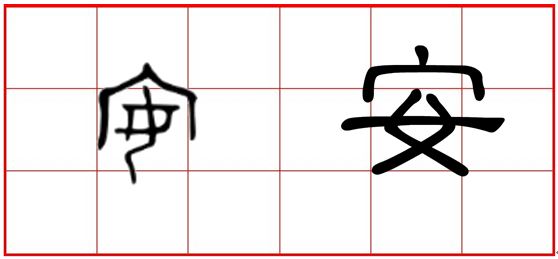
Derivation 1. Ān, peaceful

“ This woman is at home peacefully .

We already know that “Xiàng Xíng Zì“ 象形字  are the basic elements of Chinese characters. But if you want to convey an abstract idea, these words are composed of two or more of them, expressing the meaning of an idea. For example: Ān,"peace or tranquility", is a combination of "roof" and "female," meaning that everything is "peaceful" with the woman at home.


Through its meaning there are many compound words:


1.        安全 Ānquán safety


2.        安心 Ānxīn peaceful


3.        安靜Ānjìng quiet


Translated by Neil Berry


venerdì 11 dicembre 2015

象形字Xiang Xing Zi the pictographic system of Chinese characters


象形字Xiang Xing Zi the pictographic system of Chinese characters

Chinese characters in general may be referred to as ideograms, due to the fact that ideas are represented directly by characters, but they can be divided into different types, based on how they are formed or derived. Originally they consisted of pictograms (Xiàngxíng 象形), from which derived “associative compounds” (huìyì 會意), that consisted of two or more pictographs in order to form the character with the logical meaning. However, the majority originated as picto-phonic (形聲xíngshēng) which comprise  80 % of existing Chinese characters. Each Chinese character is composed of two or more picto-phonetic components that help to understand how to write and pronounce.

 
The basic components are around 200, they are known as radicals and are fundamental in the Chinese language. Therefore, once you learn these radicals, you can figure out how it was composed and the sound of a character. Make studying more effective and enjoyable! In the project “Kids Shou Bo in Chinese”, these radicals are divided into 5 sections, each section has 36 radicals accompanied by one derivation, published on the site kidshoubo.jimdo.com in the beginning of each new semester. Kids will learn 72 characters in one year. This project is completed in five years, the children will learn 500 Chinese characters, a good level for the Chinese
language.
      

 A special thanks is due to 中華文化總會THE GENERAL ASSOCIATION OF CHINESE CULTURE,GAC   http://chinese-linguipedia.org for the beautiful work they put in to Chinese culture and heritage. I trust that my work is profitable for the popularization of this interesting project. Thanking all the people who want to share my work, I wish you a happy new year 2016.    


Minhua Lin  

Shou Bo Italia


martedì 20 ottobre 2015

Baozi di Kung Fu Panda 功夫包子


Baozi di Kung Fu Panda 功夫包子

for 24 small buns o 8 big buns 

Materials for the dough

350 g of all purpose flour

200 ml of warm water 30°

1 tablespoon of yeast powder

1 teaspoon of sugar

1 tablespoon of oil ( any kind )


Materials for the stuff

300 ~500 g celery o any kind of vegetables

200~250 g minced pork

100 ml chicken broth

1 tablespoon sesame oil

1 tablespoon soy sauce

1 teaspoon salt

1 teaspoon sugar


l   Firstly prepare the minced pork mixed with vegetables.

l   Gradually pour the chicken broth and the say sauce , oil , salt and sugar.

l   Stir them all together with the chopsticks in one direction for about ten mins until it becomes sticky.

l   Now start to prepare the dough.

l   Mix the yeast inside the warm water 30°

l   Pour the yeast water gradually inside the flour bowl and mix them up.

l   Knead the dough for about 10 mins until become smooth.

l   Cover the dough with the plastic and allowed at least 8 hours o better leave one night.

l   Roll the dough long e cut it into 8 even pieces ( big size .)

l   Roll the small piece round and flat. Sprinkle some flour to prevent the dough from sticking.

l   Start to put the stuff inside and make shape out of the dough and wrappe it up.

l   Let the buns rest inside the steamer for at least 15 mins

l   Put the cold water in the pot and turn the gas to high-medium heat.

l   When the water boiled and steam the buns for 15 mins ( Do not open the lid )

l   Turn the gas and open the lid five – eight mins later.

l   Now you can enjoy the Baozi !!!


venerdì 2 ottobre 2015

象形字 Xiang Xing Zi How to learn the Chinese Character ?


Progetto “Kids Shou Bo in Chinese” anno 2015

 
Kids Shou Bo in Chinese “ was born in 2014, the headquarters for the lessons is in Lodi ( Lombardia, Italy ) where I first taught five children, it was a success, much appreciated both by children and parents. In this new season – 2015/- 2016, with the encouragement of Master Yuan Zumou and Master Stefano Danesi, I would like to propose to you this interesting project.

  All summer I studied and thought about how to re- introduce this valuable project, allowing more schools to get to know it, make it more acceptable and share it with everyone.

 Everyone thinks that learning to speak the Chinese language is very difficult, let alone to learn to write it. As a matter of fact, it is not so. All languages have their own system. The Chinese system is named 象形字Xiang Xing Zi, commonly known as a pictogram or ideogram system, but more specifically it is a system that based on picto-phonics.


 Chinese characters in general may be referred to as ideograms, due to the fact that ideas are represented directly by characters, but they can be divided into different types, based on how they are formed or derived. Originally they consisted of pictograms (Xiàngxíng 象形), from which derived “associative compounds” (huìyì 會意), that consisted of two or more pictographs in order to form the character with the logical meaning. However, the majority originated as picto-phonic (形聲xíngshēng) which comprise  80 % of existing Chinese characters. Each Chinese character is composed of two or more picto-phonetic components that help to understand how to write and pronounce.


 The basic components are around 200, they are known as radicals and are fundamental in the Chinese language. Therefore, once you learn these radicals, you can figure out how it was composed and the sound of a character. Make studying more effective and enjoyable!
 

  In the project “Kids Shou Bo in Chinese”, these radicals are divided into 5 sections, each section has 36 radicals accompanied by one derivation, published on the site kidshoubo.jimdo.com in the beginning of each new semester. Kids will learn 72 characters in one year. This project is completed in five years, the children will learn 500 Chinese characters, a good level for the Chinese language.
 

 The system, used in the project “ Kids Shou Bo in Chinese “ was not created by me but is an original form of written Chinese language, it was born with engravings on tortoise shells and ox bones甲骨文 Jia Gu Wen. It dates back more than 4000  during the Shang dynasty, these Jia Gu Wen were made with oracle texts and songs relating to divination rituals. More than 100.000 fragments have been found and scientists and professors are able to identify approximately 4500 different characters, including 1700 already decoded. Thanks to Taiwan the findings have been published, so the world has the opportunity to share this heritage of authentic and valuable culture.
 
 " Culture is life and life is beautiful" l would like to recite this famous line to all of you and pass it on to our children with the same goal to grow together with them!!!
  
   Minhua Lin       
   Bertonico   3 October, 2015